Autonomous Robot Exploration on a Kobuki Turtlebot2
Hands-On Planning
Collaborator(s): Lisa Paul, Fatima Yousif
Overview
This project presents the development of a frontier-based exploration system for autonomous navigation using an RGB-D camera mounted on a Kobuki Turtlebot2. The objective is to enable the robot to autonomously explore unknown environments by identifying and navigating to frontiers, which are the boundaries between known and unexplored areas. This approach integrates advanced path planning and control algorithms to enhance the efficiency and accuracy of autonomous navigation and mapping.
Our system uses connected component labeling to detect and cluster frontiers, selecting exploration targets based on maximum information gain. The integration of RRT* (Rapidly-exploring Random Tree Star) algorithm with Dubin’s path strategies allows for efficient path planning while ensuring smooth navigation in open spaces. However, challenges were identified in tight spaces, which were addressed through parameter tuning during testing. Additionally, the robot’s velocity and direction were controlled by a hybrid system combining a PID Controller for velocity stability and a Pure Pursuit Controller for direction management, particularly useful in dynamic environments.
Methodology
The project employs a combination of path planning and control algorithms:
- Frontier Detection and Clustering: The system detects and clusters frontiers using connected component labeling, selecting exploration targets based on maximum information gain.
- RRT* (Rapidly-exploring Random Tree Star): Used for efficient path planning, allowing the robot to explore unknown environments while avoiding obstacles.
- Dubin’s Path Strategies: These were integrated with RRT* to provide smooth, curvature-constrained paths that optimize the robot’s navigation in open spaces.
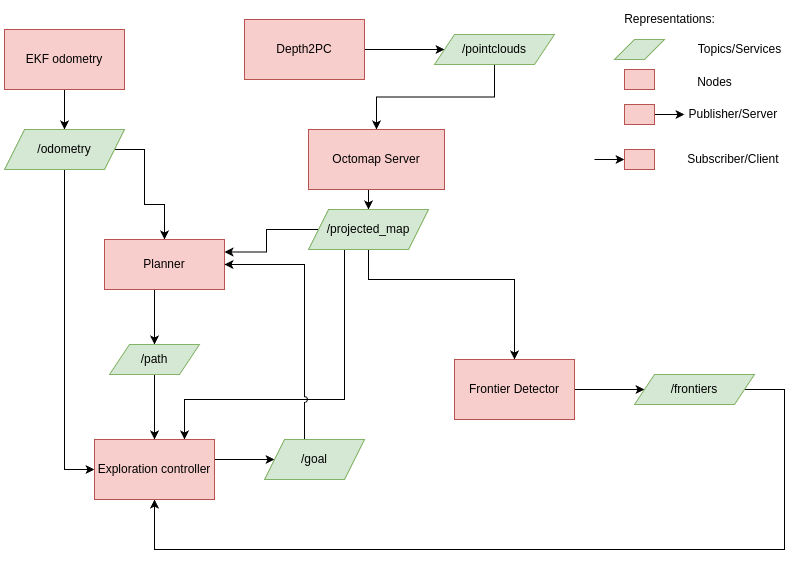
The system was developed in Python and implemented within the Robot Operating System (ROS) framework. Preliminary testing and algorithm tuning were carried out in the Stonefish simulation environment, with further validation performed in real-world scenarios using the Kobuki Turtlebot.
Results
The results demonstrated the effectiveness of our approach in achieving efficient path planning, exploration coverage, and overall system performance. The integration of RRT* with Dubin’s paths facilitated smooth navigation, while the PID and Pure Pursuit controllers ensured precise control. Both the simulation and real-world tests yielded successful exploration and mapping outcomes, although further refinement in parameter tuning is necessary for constrained environments.